
CoinJoin Explained: How Bitcoin Privacy Mixing Actually Works

CoinJoin is a Bitcoin privacy technique that merges several people’s transactions into one, so a blockchain observer can’t tell which input paid which output. It doesn’t hide amounts or add cryptographic privacy the way Monero’s ring signatures do. It just makes the ownership trail ambiguous, and only for the specific round of coins that got mixed.
Key takeaways: CoinJoin breaks the direct link between sender and receiver by batching multiple payments into one transaction with equal-value outputs. The two biggest coordinator-based services, Wasabi and Samourai’s Whirlpool, both went down in April 2024 after US law enforcement action. JoinMarket, which has no central coordinator to seize, is still running. None of this makes Bitcoin as private as a purpose-built privacy coin, and this guide covers exactly where the line is.
Where CoinJoin Came From
The concept was proposed in 2013 by Gregory Maxwell, one of Bitcoin Core’s own developers, in a Bitcointalk forum post. The pitch was straightforward: Bitcoin’s ledger is public and pseudonymous, not anonymous, so anyone who links a single address to your identity can trace your entire transaction history backward and forward from there. CoinJoin was one of the first serious proposals to break that link without changing Bitcoin’s base protocol at all. Everything since, Wasabi, Samourai’s Whirlpool, JoinMarket, is a different implementation of that same 2013 idea.
What Actually Happens in a CoinJoin Transaction?
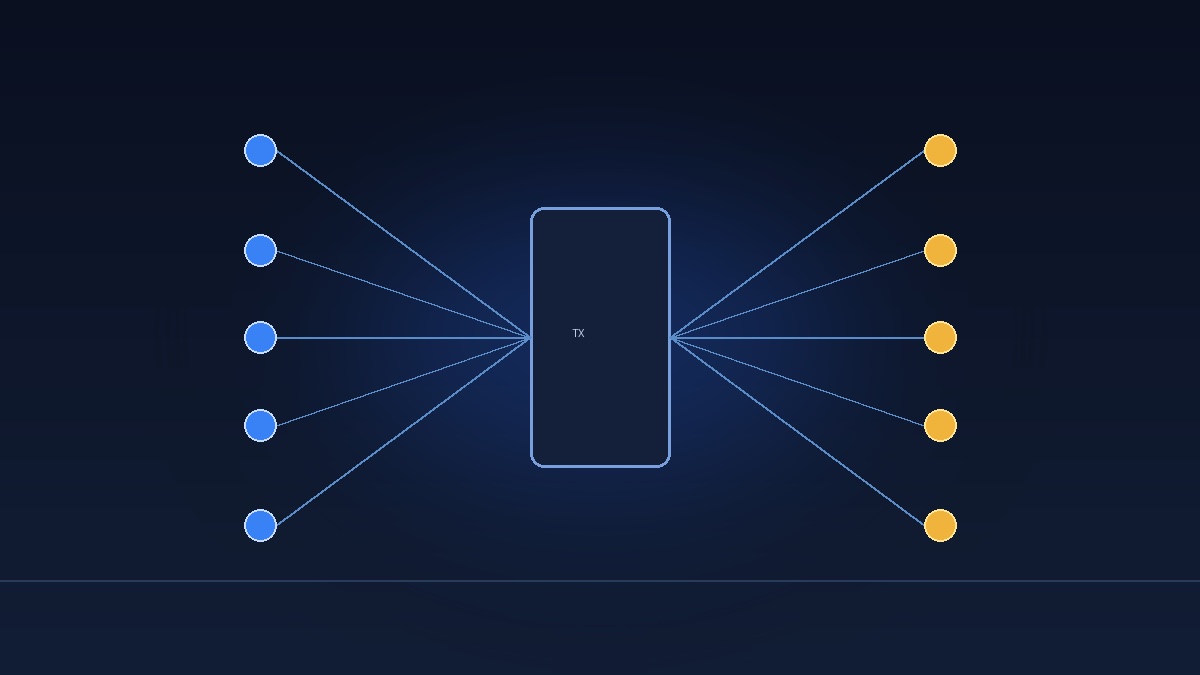
Picture five people who each want to send roughly 0.1 BTC to someone else. Normally, each of those would be a separate, fully traceable transaction: input A to output A, input B to output B, and so on. Anyone watching the chain can follow the money in a straight line.
A CoinJoin transaction bundles all five inputs and all five outputs into a single transaction, with every output set to the same round amount (say, exactly 0.1 BTC each). Now an outside observer sees five inputs and five equal outputs in one transaction and has no cryptographic way to know which input paid which output. The link isn’t destroyed, it’s just no longer provable from the chain data alone.
This only works because the outputs are equal. If one output were 0.1 BTC and another were 0.347 BTC, the odd amount would stand out and partially reveal the pairing. That’s why CoinJoin wallets round transaction amounts and often require multiple rounds to build up meaningful ambiguity.
Wasabi Wallet and the Coordinator Model
Wasabi Wallet, built by the company zkSNACKs, ran a centralized coordinator that organized these mixing rounds. Users connected to the coordinator, which matched up inputs and outputs from many participants at once and used a technique called Chaumian blind signatures so the coordinator itself couldn’t see which input belonged to which output, even while facilitating the round.
The design was clever, but it had one structural weakness: there was a server. A server can be subpoenaed, seized, or shut down. And that’s exactly what happened.
Samourai Wallet’s Whirlpool
Samourai Wallet ran its own CoinJoin implementation called Whirlpool, built around the same equal-output concept but with its own coordinator infrastructure and a slightly different mixing pool structure (fixed denominations like 0.5, 0.05, 0.01 and 0.001 BTC pools). Whirlpool was popular specifically because it integrated tightly with Samourai’s mobile wallet, making it one of the easier CoinJoin tools to actually use day to day.
Why the DOJ Shut Two of Them Down in April 2024
In April 2024, the US Department of Justice arrested the Samourai Wallet founders on money-transmitter charges and seized the servers running Whirlpool. In the same week, Wasabi’s parent company zkSNACKs shut down its own coordinator rather than risk the same outcome. Both services stopped functioning almost overnight, not because the cryptography failed, but because both had a centralized point that law enforcement could reach.
Holding Bitcoin that was previously mixed through either service isn’t illegal. Running the coordinator infrastructure is what drew the charges. That distinction matters if you’re trying to understand what actually happened here.
JoinMarket: The One That Survived
JoinMarket takes a completely different approach: there is no coordinator to shut down. Instead, it runs on a market model. “Makers” advertise liquidity through a decentralized order book (traditionally over IRC, with Tor support), offering to participate in CoinJoin rounds for a small fee. “Takers” who want to mix their coins pay that fee and initiate a round directly with willing makers.
Because there’s no central server coordinating everyone, there’s nothing equivalent to seize. The tradeoff is usability: JoinMarket has a steeper learning curve than Wasabi or Samourai ever did, and it’s the main reason it never reached the same mainstream adoption despite surviving where the easier options didn’t.
How Private Is CoinJoin, Really?
CoinJoin’s anonymity set, the group of people you’re hiding among, is limited to whoever participated in that specific mixing round. Compare that to Monero, where every single transaction on the network is private by design and the anonymity set is the entire chain’s transaction history. A CoinJoin round with 20 participants gives you a much smaller crowd to disappear into than a coin where privacy is mandatory for everyone.
Chain-analysis firms have also published heuristics specifically targeting equal-output CoinJoins. Techniques like tracking which outputs get spent together afterward, or flagging wallets that consistently participate in the same coordinator’s rounds, can partially cluster CoinJoin activity even without breaking the mixing itself. It’s not a complete break of the privacy, but it’s a real limitation worth knowing about before you treat a mixed UTXO as untouchable.
For a deeper look at what privacy coins do differently at the protocol level, see our explainer on what privacy coins are and how they work, and our head-to-head comparison of Monero and Zcash.
Common Mistakes That Undo a CoinJoin
- Spending mixed and unmixed coins together. If you combine a freshly mixed output with an unmixed coin in the same transaction, you’ve just linked them and undone the mix.
- Consolidating change outputs too early. Change from a CoinJoin round often needs another round or careful handling before it’s safe to spend without re-linking your history.
- Reusing the same address after mixing. Address reuse defeats the point regardless of how private your mixing was upstream.
- Only doing one round. A single CoinJoin round provides meaningfully less ambiguity than several rounds run over time.
- Assuming mixed coins are permanently untraceable. Clustering heuristics improve over time. Treat CoinJoin as raising the cost of tracing, not eliminating it.
Should You Use CoinJoin, or Switch to a Privacy Coin?
CoinJoin makes sense if you’re committed to holding Bitcoin specifically and want to add friction against casual chain analysis. It requires ongoing effort: multiple rounds, careful UTXO management, and accepting that your anonymity set is only as large as who else mixed alongside you.
If privacy is the actual goal rather than a bonus feature, a coin built around privacy from the protocol layer up, like the two we cover in our most secure crypto for anonymity breakdown, gives you that by default on every transaction instead of as an optional, effortful add-on. Many privacy-focused users do both: hold Bitcoin as their base asset and route anything sensitive through a privacy coin instead of trying to make Bitcoin do a job it wasn’t originally built for. Whichever route you take, the wallet you use matters as much as the technique. Our crypto wallet guide covers what to look for.
FAQ
Is CoinJoin illegal?
No. Using CoinJoin to mix your own coins isn’t illegal in the US or most jurisdictions. The April 2024 charges against the Samourai Wallet founders were for running unlicensed money-transmitter infrastructure, not for the act of mixing itself.
Can I still use Wasabi or Samourai wallet?
The wallets themselves may still function for basic use, but their CoinJoin coordinators are shut down, so neither can facilitate new mixing rounds. JoinMarket remains the main actively working CoinJoin option.
Is CoinJoin as private as Monero?
No. CoinJoin’s privacy depends on the size and behavior of a specific mixing round and can be partially clustered by chain-analysis heuristics. Monero applies ring signatures, stealth addresses and RingCT to every transaction by default, giving it a much larger and more consistent anonymity set.
Do I need technical skill to use JoinMarket?
More than a typical wallet, yes. JoinMarket generally runs from the command line or a companion GUI and requires understanding makers, takers, and order books, which is a steeper learning curve than a one-tap mix in a mobile wallet.
What happened to the coins that were already mixed through Whirlpool or Wasabi?
They remain valid, spendable Bitcoin. The privacy benefit already applied to those specific transactions doesn’t disappear because the coordinator shut down; it just means no new rounds can happen through those particular services.
Why did Wasabi and Samourai need a coordinator at all if JoinMarket doesn’t?
A coordinator makes the experience faster and more automatic: it finds enough participants and organizes the round on your behalf in seconds, which is why Wasabi and Whirlpool felt closer to a normal wallet feature. JoinMarket’s maker-taker order book does the same matching job without a central party, but someone still has to be online and willing to trade liquidity at any given moment, which is slower and less predictable by design.
